
70°C Dubai Solar Street Light Proof for DPWH Projects in the Philippines
When contractors prepare for DPWH and LGU road lighting bids in the Philippines, one question always comes first:
Can solar street lights truly survive 5–7 years in tropical heat, long rainy seasons, coastal humidity, and typhoon-prone environments?
Instead of relying on theory, we prefer to answer this question with real engineering evidence.
Our 1,000-unit solar street light deployment in Dubai has been operating continuously since 2019, through multiple extreme summer cycles where fixture surface temperatures regularly exceeded 70°C.
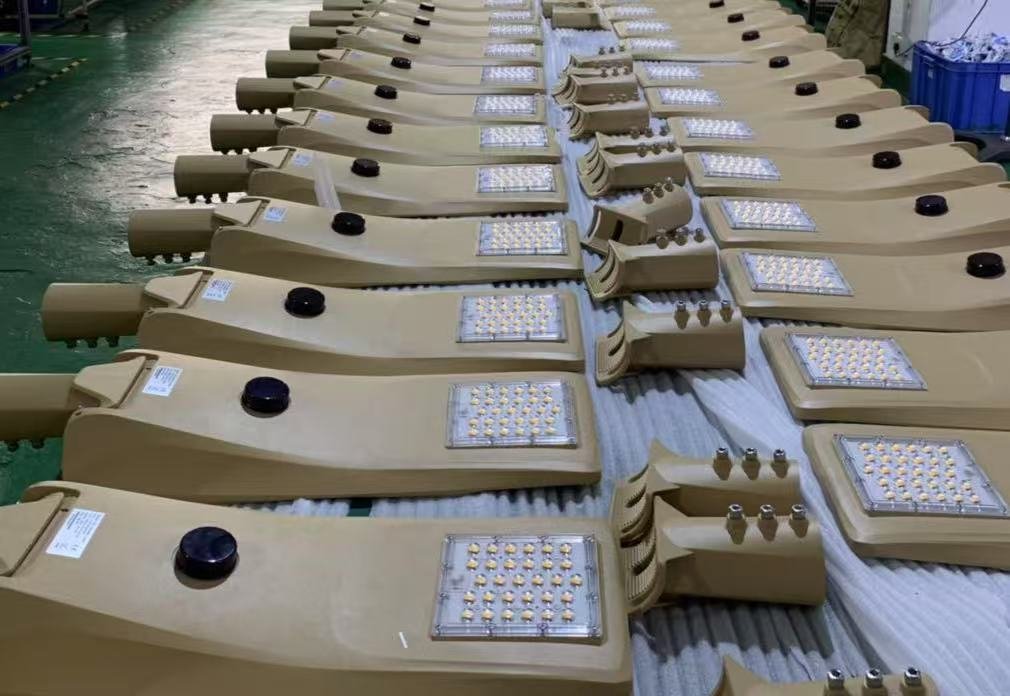
View our complete 2019 case study: Custom "Royal Gold" Sunpro Solar Street Lights Installation in Dubai
The lessons from this project are directly relevant to Philippine municipal roads, provincial highways, barangay access roads, and public infrastructure upgrades where long-term maintenance cost matters more than the initial unit price.
Lesson 1: Heat Damages Batteries Faster Than Rain
Many project owners in the Philippines focus heavily on rainy season performance. However, in real engineering practice, high internal fixture temperature often shortens battery life faster than rain itself.
In Dubai, ambient temperatures above 45°C pushed internal battery chamber temperatures beyond 60°C whenever poor thermal paths existed. This is exactly why many low-cost public-mold solar street lights fail within 1–2 years.
For this 1,000-unit deployment, our engineering team optimized several key areas:
- ✔ Real-capacity and 100% brand-new LiFePO4 batteries for extended lifespan
- ✔ Advanced MPPT controller preventing overcharge & deep depletion
- ✔ Advanced ITC (Intelligent Temperature Control) system
- ✔ Smart high-temperature auto-protection logic
- ✔ Fireproof EVA foam for extreme thermal insulation
- ✔ Aluminum heat dissipation & optimized airflow channels
These same risks are highly relevant in Manila, Cebu, Davao, and many coastal Philippine municipalities, where tropical heat combines with enclosed fixture housings to accelerate battery aging. This is exactly why we strongly recommend 100% brand-new LiFePO4 systems for DPWH-standard projects instead of recycled batteries or heat-sensitive ternary batteries (learn more).
Lesson 2: Structural Reliability Matters More Than Wattage
Many suppliers still sell projects using wattage numbers alone. But the Dubai project proved that structural reliability determines the true lifecycle cost of every pole.
For large-scale road lighting projects, the real engineering concerns are:
- bracket deformation
- wind-load resistance
- anti-vibration performance
- waterproof sealing stability
- corrosion resistance
- mounting arm fatigue
In this deployment, we used:
- ✦ die-cast aluminum housing
- ✦ reinforced steel brackets
- ✦ 304 stainless steel fasteners
- ✦ anti-loosening vibration joints
- ✦ wind-load-tested mounting arms
For DPWH road widening, bypass roads, and municipal streets in typhoon-exposed regions, these structural details are often more critical than lumen output alone. A brighter fixture means little if the housing fails after two monsoon seasons.
Lesson 3: Long-Term Maintenance Cost Is the Real KPI
The most valuable result of this Dubai project is not the initial installation scale. It is the long-term maintenance record after years of extreme operation.
After multiple summer cycles, the project maintained:
- ✔ zero battery swelling
- ✔ zero housing cracks
- ✔ zero bracket deformation
- ✔ stable overnight lighting performance
- ✔ minimal maintenance intervention
For Philippine contractors, this directly translates into:
- lower 5–7 year maintenance cost per pole
- fewer post-installation complaints
- better DPWH / LGU audit confidence
- stronger protection against “overpriced but low-quality” concerns
- easier future project references
In real bidding environments, this lifecycle performance often matters more than a lower initial quote (check our DPWH guide).
Why This Dubai Case Matters for DPWH Projects in the Philippines
The Philippines does not face Dubai’s extreme dry heat, but it presents another difficult combination:
- tropical heat
- long rainy seasons
- salty coastal air
- unstable municipal maintenance
- frequent typhoon exposure
Because this Dubai project has already proven stability under harsher thermal stress, it provides strong engineering confidence when adapted to Philippine deployment conditions.
For contractors bidding on DPWH, LGU, subdivision, and municipal road projects, this case offers practical evidence that long-term solar lighting reliability is achievable with the right system design.
Frequently Asked Questions (FAQ)
Q1: How long can solar street lights last in tropical climates like the Philippines?
A1: With high-quality LiFePO4 batteries, optimized heat dissipation, and robust housings, solar street lights can reliably last 5–7 years even under tropical heat, heavy rain, and coastal humidity.
Q2: Do high temperatures affect battery life more than rainy seasons?
A2: Yes. Poor internal heat management often causes batteries to degrade faster than water exposure. Projects like our 1,000-unit Dubai deployment prove that a multi-layered protection system—combining brand-new LiFePO4 cells, smart MPPT control, and ITC thermal management—is the true key to longevity.
Q3: What is more important for long-term performance: wattage or structural reliability?
A3: Structural reliability matters more. housing strength, anti-wind design, vibration resistance, and waterproof sealing are the key factors that determine maintenance costs over the lifecycle of a project.
Q4: How can Philippine contractors reduce long-term maintenance risks?
A4: The foundation is refusing second-hand components. Always select 100% brand-new LiFePO4 batteries and heavy-duty die-cast aluminum for typhoon-level wind resistance. Combined with strict adherence to DPWH technical guidelines for other installation details, this approach minimizes maintenance risks and guarantees project stability
Q5: Can lessons from Dubai be applied directly to DPWH projects in the Philippines?
A5: Absolutely. While climate conditions differ, engineering solutions for heat management, battery protection, and structural reliability translate directly to tropical Philippine projects, reducing risks and ensuring compliance.
Need a DPWH-Ready Solar Street Light Proposal?
If your next Philippine road lighting project needs:
- ✔ Dialux simulation
- ✔ 6m / 9m pole spacing
- ✔ LiFePO4 battery lifecycle estimation
- ✔ DUPA budget support
- ✔ anti-typhoon bracket design
- ✔ road classification compliance advice
our engineering team can help prepare a project-ready proposal based on real extreme-climate deployment experience.